|
Sharm Blasts…What Lies Beneath
 |
|
The
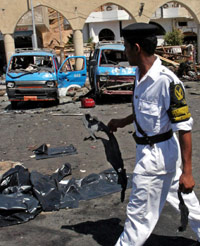
blasts raised more questions than answers. (Reuters)
|
By
Mohammad Gamal Arafa, IOL Staff
CAIRO,
July 24, 2005 (IslamOnline.net) – Though some experts and security
pundits have pointed the finger for recent terrorist attacks that hit
Egypt at a "third generation" of Islamist groups subscribing
to Al-Qaeda ideology, the July 23 bombings in Sharm El-Sheikh opened
the door for a new array of analyses and readings into the reasons and
the message behind one of the worst attacks in Egyptian history.
The
multiple bombings, which ripped through a seafront hotel, a car park
and a busy market area in the Red Sea diving resort and killed at
least 64 people, were timed to coincide with Egypt's celebration of
the 53rd anniversary of the July
Revolution against a corrupt monarchy.
It
seems as if the attackers tended to strike in national festivities
playing on potential security lax or even to cast a heavy cloud on the
joyful atmosphere.
The
October 6 bombings which hit tourist attractions in Taba and Nuweiba,
when the Egyptians were celebrate the liberation of Sinai from Israeli
occupation forces, are a case in point.
Saturday’s
bombings also coincided with the trial of three Taba suspects,
including one at large, in the city of Ismailiya, some 120 km from
Cairo.
Egyptian
Interior Minister Habib El-Adly said immediately after the attacks
that they have "leads" suggesting that the Sharm El-Sheikh
attacks were linked to the Taba bombings.
International
human rights watchdogs have criticized Egyptian authorities for
randomly arresting thousands of Sinai Bedouins in the aftermath of the
Taba bombings, an iron fist policy that outraged the detainees'
families.
“Third
Generation”
 |
|
Most
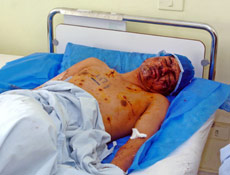
of the victims were Egyptians. (Reuters)
|
The
Sharm blasts also showed that the attackers sought to triggering
panic and bring in blood and destruction even at the cost of
innocent lives.
Some
believe that they might be the work of untrained young Egyptians,
who are influenced by Al-Qaeda ideology but are not operating
under its auspices.
Two
unknown groups, the Mujahdeen Egypt and Sinai Martyrs Brigades,
have claimed the multiple bombings but distanced themselves from
Osama Bin Laden’s network.
The
Taba blasts and recent attacks against tourists in Cairo sent the
message that the perpetrators were targeting the crucial tourism
sector, heralding a "third generation" of violent groups
like the ones terrorizing the country in 1980s and early 1990s.
Analysts
believe that this third generation is made up of young people who
only heard about violent groups like the Jihad and Jama'a Islamia
(Islamic Group).
They
are driven by a sheer hatred toward the "anti-Islam"
West and are firmly of the view that their Arab regimes are,
willingly or unwillingly, toeing the western line.
The
most likely scenario is that this new generation of terrorists is
not linked to these groups or their leaders.
The
sure thing is that they subscribe to the same Al-Qaeda ideology,
which mainly champions armed attacks on US and Israeli interests.
Besides
security officials have discredited Al-Qaeda claims of the attacks
as they are convinced now that all these groups are only wedded
into the same ideology and do not operating under an umbrella
organization.
Unprecedented
 |
|
Thousands
of tourists have flown out of Sharm El-Sheikh following the
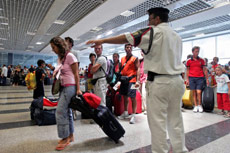
attacks. (Reuters)
|
The
massive destruction caused in Sharm El-Sheikh revealed that the
bombers wanted to exact a heavy toll on the city and send
shockwaves across the country’s political landscape.
The
bombings have also targeted this time a place where President
Mubarak spends much of his time and has become a second seat of
power.
The
picturesque city has also become a favorite venue for
international conferences and events.
The
recent spate of attacks are also ringing alarm bells, as the
suicide bombings are unprecedented in the country.
On
April 7, a man killed himself and three tourists when the bomb he
was carrying exploded among a group of tourists in the historical
Al-Azhar district downtown Cairo.
Days
later, a suicide bomber struck on April 30 at foreign tourists
near Egypt's most famous museum.
The
attacks further suggest that the culture of violence and
explosions is gaining ground, a phenomenon fed up by the growing
frustration, desperation and towering unemployment rates among
Egyptian and Arab youths.
Mossad
Hands?
The
Mossad link is also one of the possible scenarios in any
terrorists strike – even in London.
The
Sharm blasts, according to analysts and politicians, gave weight
to this possibility with the aim of dealing a fatal blow to
Egypt’s tourism bonanza and economy.
"It
is as clear as day that Mossad is behind the Sharm blasts to
terrify innocent people, wage war on the Arabs and spark confusion
and sedition," Hussein Rashid, the deputy chairman of the
Egyptian Misr Al-Fatat party, said on the party’s Web site.
"The
Mossad knows that Sharm El-Sheikh is the jewel of Egypt's tourism
industry and has been known for its tranquil and peaceful
atmosphere, and they managed to kill two birds with one stone.
Egyptians could not have committed such a heinous crime," he
added.
Pundits
further believe that the bombings might have also been designed by
Mossad to press Cairo into "silently" nodding in
agreement at the planned Israeli withdrawal from the Gaza Strip
and stop talking about it as a part of the internationally-backed
roadmap or about a comprehensive settlement to the
Israeli-Palestinian conflict.
Israeli
Premier Ariel Sharon confirmed on Friday, July 22, that Israel and
Egypt will conclude a deal allowing the deployment of 750 Egyptian
border policemen along the southern edge of the Gaza Strip, an
area adjacent to Rafah known as the Philadelphi Route, according
to Israeli Haaretz newspaper.
The
daily said that the remaining differences between revolve around
Israel's demand to take responsibility for the prevention of
cross-border smuggling between Egypt and the Palestinian
Authority.
Analysts
have additionally smelled a rat given that most of the 64 victims
were Egyptians, while some 10,000 Israeli tourists are holidaying
in the Sinai peninsula.
Westerners
usually avoid Sharm El-Sheikh in summertime when temperature rise
to a searing 40 Celsius.
Moreover,
the hit areas are usually frequented by Egyptians, particularly
the old market place and the car park.
What
Now?
Undeniably,
the vital Egyptian tourism, the country's main foreign currency
earner ($6.6 billion annually) and biggest private sector
employer, will take the brunt of the attacks.
Thousands
of shell-shocked tourists have already flown out of Sharm
El-Sheikh.
Though
Tourism Minister Ahmed El-Maghrabi predicted a
"short-term" impact, analysts predict the worst-case
scenario as the terrorists struck the country’s flagship resort.
The
heavy death toll, which was revised down from 88 by the Health
Ministry Sunday, the destruction wrecked on the resort and not to
mention the reoccurrence of blasts and attacks against tourists
over the past nine months are all indicative of grave consequences
on the onetime booming tourism sector in the days to come.
The
opposition powers are also expected to lambaste the government for
failing so far to redress loopholes in the 1978 Camp David peace
agreement with Israel, which obliged Egypt to keep only
lightly-armed policemen in the Sinai peninsula.
The
opposition will also press ahead with its calls to abolish the
notorious emergency law, in force since 1981, as it failed to
thwart terrorist operations and is only being used as a ruse to
crack down on personal freedoms and free speech.
The
attacks will further throw a spanner in the reform process and
buoy calls by the ruling National Democratic Party (NDP) to
nominate Mubarak for a new term in office to "enhance
stability".
Mubarak,
77, is widely expected to seek a fifth term though he is yet to
publically announce he is standing.
The
newly created electoral commission said Sunday that the
country’s first multi-candidate presidential elections will take
place on September 7.
|