|
"Euro-Islam" Hailed in Tatarstan
 |
|
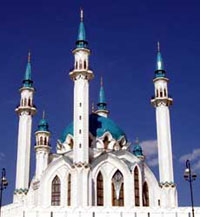
A file photo for the Qul Sharif Mosque in Tatarstan, considered to be Europe’s largest mosque.
|
KAZAN,
August 4, 2005 (IslamOnline.net & News Agencies) – Tatarstan,
this small republic in the east-central part of European Russia, has
been widely seen as the center of an emerging brand of Islamic thought
dubbed “Euro-Islam.”
The
republic, home to Europe’s largest mosque, has set itself up as a
paradigm of peaceful co-existence, which helped its half-Muslim,
half-Orthodox region become one of the most prosperous in this part of
the world, Australia's ABC network has reported.
Whether
secular or conservative, it does not matter in Tatarstan where one can
find hijab-clad women strolling next to non-Muslims wearing stilettos,
the broadcaster said.
In
the streets of the capital Kazan, you can see mosques push up against
casinos, and Arabic is almost as common as Cyrillic alphabet, used to
write six Slavic languages: Belarusian, Bulgarian, Macedonian,
Russian, Serbian, and Ukrainian.
This
is attributable to the merciful teachings of Islam, which preach
democracy and tolerance as well as a secular society.
Democratic
Democracy
is one of Tatarstan’s milestones as people do have the final say on
their leaders.
“One
point of pride is that every Muslim in Tatarstan has a say in who
leads them,” Valivalla Yuggovbov, from the Muslims of Russia
Organization, told ABC.
“On
the lowest level simple Muslims elect their own imam. And in the
regions all these imams later appoint a mufti,” he said.
According
to Yuggovbov, Muslim women in Tatarstan have more power than women in
many Middle Eastern countries.
“These
Muslim ladies have their own hierarchy, the well-educated ladies are
called podisteys and they teach all the people to the special
features of Islam, and thanks to that by the beginning of the 20th
century all Tatar people were well-educated,” he explained.
Over
the past decade, Tatarstan has seen a revival of Islamic teachings
along with all religious thought.
"In
that time, more than a thousand mosques have been built in the region
and an Islamic university has flourished. The Muslim-dominated
Government has embraced commerce, and Orthodox and Muslim residents
have both felt the benefits."
Problems
Muslim
women, however, still encounter some minor problems in Tatarstan's
peaceful community due to a misunderstanding raised on their clothing.
"You
see for example our ladies should cover their body and they cannot
show any part of their body except for their face and hands. But it is
difficult for people to see the ladies who wear miniskirts and
sometimes not cover their bodies at all," said Gabarashid
Zakirov, the Assistant Deputy Mufti at the Islamic University in
Tatarstan.
"And
there are people who do not understand that Muslim women when they
wear clothes that cover the whole of their body and they say that it's
not normal. But as long as we live in a democratic country, if women
can walk naked, so it means she can wear something else except
that."
Tatarstan
is situated in the center of the Russian Federation on the
East-European Plain at the confluence of the two greatest rivers - the
Volga and the Kama.
Since
the early days of Islam, individual Muslims and delegations visited
the region of Volga-Bulgaria, today's Tatarstan.
By
the year 922, Islam had spread in the region and had been adopted as
an official religion.
At
the beginning of the 13th century, Volga-Bulgaria was captured by the
Mongols and forcibly included into the Golden Horde.
By
the beginning of the 15th century, the Golden Horde, which by then was
a Muslim state, had broken down into several states, the strongest of
which was Kazan Khanate.
In
1552, Kazan fell to the invading troops of Ivan the Terrible and Islam
was persecuted until the end of the 18th century.
|