|
Iran Resumes Nuclear Work, Crisis Looms
 |
|
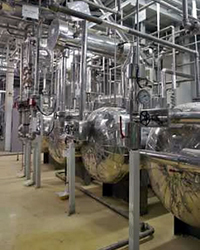
An inside view of a Uranium Conversion Facility producing unit in Isfahan. (Reuters)
|
ISFAHAN,
Iran, August 8, 2005 (IslamOnline.net & News Agencies) – Under
the supervision of the UN atomic watchdog, Iran resumed Monday, August
8, ultra-sensitive nuclear fuel work at its uranium conversion plant
in Isfahan despite warnings from the European Union and Washington.
"Iran
has resumed the conversion of uranium under the supervision of the
International Atomic Energy Agency," the vice-president of Iran's
Atomic Energy Agency Mohammad Saidi told journalists, according to
Agence France-Presse (AFP).
The
move, which risks seeing Iran hauled before the UN Security Council,
comes after Iran rejected as "unacceptable" a package of EU
proposals aimed at guaranteeing that it was not trying to build a
nuclear weapon.
"The
EU proposal was very insulting and humiliating," Saeedi said.
At
the uranium conversion facility near the central Iranian city of
Isfahan, two workers wearing white overalls, face masks and hard hats
lifted a barrel full of uranium yellow cake, opened its lid and fed it
into the processing line, Reuters reported.
A
nuclear scientist, who declined to be named, told Reuters: "I am
excited, I didn't believe it until the last moment thinking this may
not happen, but now I am very happy."
Saidi
said that Iran had started processing uranium into a substance called
uranium tetrafluoride (UF4) and would then begin turning into the feed
gas known as uranium hexafluoride (UF6) by Wednesday.
He
said the production would be stocked in Iran for use when the country
resumes enrichment, adding that there was never any intention of it
being exported.
Tehran
insists however that actual enrichment remains suspended at the
underground Natanz plant and that it still wants to pursue
negotiations with the Europeans.
Iran
had insisted it would resume the process despite numerous warnings
from the United States and the Europeans.
Conversion
turns uranium ore or yellowcake into a feed gas for enriching uranium,
which can be the fuel for reactors or the explosive core of atom
bombs.
IAEA
inspectors installed security cameras to monitor the initial
conversion process and an AFP correspondent saw technicians in
protective clothing opening the barrel of yellowcake.
The
EU, which has been negotiating with Iran for nine months, had already
called for an emergency meeting Tuesday of the IAEA board during which
an ultimatum demanding a commitment to suspend nuclear fuel work is
expected.
Larijani
The
crisis has escalated since Iran's President Mahmood Ahmadinejad took
office last week, with the new leader Monday putting what the west
sees as "a fellow hardliner" in charge of the nuclear
dossier.
A
government spokesman said Ali Larijani, a former boss of state-run
media who has distinguished himself by his intransigency over Iran's
nuclear ambitions, would soon take up the post.
Larijani
replaces Hassan Rowhani, who has managed to maintain dialogue with the
West through thick and thin over the last two years, and his
appointment will worry some Western negotiators.
Larijani
has described giving up Iran's right to uranium enrichment in exchange
for EU incentives as like swapping "a pearl for a sweet".
Iran's
parliament had demanded that uranium conversion resume ahead of
Tuesday's meeting of the IAEA governors, outside the watchdog's
supervision if necessary.
The
United States, which is not a party to the EU offer, charges that Iran
is using its civilian program as a cover to secretly develop nuclear
weapons, something Iran has always denied.
US
Response
Responding
to Iran's decision, a State Department official said Monday his
country considers reports that Iran has restarted nuclear activities
"unfortunate" and would expect Tehran to be taken before the
United Nations, AFP reported.
"If,
in fact, they have just taken measures to restart uranium conversion,
... it would be unfortunate," the unnamed US official told AFP,
adding that he expected a board meeting of the IAEA this week to take
"appropriate action."
"We've
said all along that should Iran break the seals and restart uranium
enrichment at Isfahan or anywhere else, we would think an appropriate
response would be a referral to the United Nations."
|