|
Stampede…Showdown of Sunni-Shiite Solidarity
 |
|
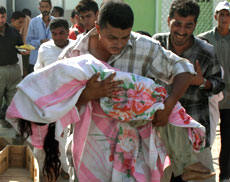
An
Iraqi man carries a body in Baghdad's Sadr City for burial after
the killer stampede. (Reuters)
|
By
Mazen Ghazi, IOL Correspondent
BAGHDAD,
September 1, 2005 (IslamOnline.net & News Agencies) – A crisis
always poses a threat and an opportunity. The tragic stampede that took
the lives of almost a 1,000 Shiites Wednesday, August 1, has proved to
be a crisis that was translated into a chance to highlight communal
harmony in the occupied country.
While
the huge loss of life made the dark side of the crisis, Sunnis rushed to
help and leaders of both sects were quick to accept the fateful accident
while blaming US-led occupation for the rise of sectarian divisions,
making the bright side of the human tragedy.
Tens
of Al-Aazamiya residents, Sunnis and Shiites, did not hesitate in
jumping into the Tigris river to save hundreds of women and children,
who fell off Al-Aaimmah (Imams) Bridge into the river following the
stampede, eyewitnesses told IslamOnline.net Thursday, September 1.
Residents
of the predominantly-Sunni Aazamiya, which oversees the Tigris river,
also used their boats to pick up hundreds of Shiite pilgrims from the
river as they were fighting death roaming overhead.
More
than 1,000 Iraqi Shiites were killed Wednesday in a stampede off a
bridge over the Tigris river in Baghdad.
Many
of the dead drowned after falling off the Al-Aaimmah bridge into the
Tigris river in a surge of panic triggered by rumors that suicide
bombers were in the crowd.
The
stampede occurred when the crowd were marching to Al-Kadhimiya mosque in
Baghdad's Al-Kadhimiya district to commemorate the death of
the seventh imam, Musa Al-Kadhim, a revered religious figure among the
Shiites.
Funeral
tents were erected Thursday in the impoverished Baghdad Shiite suburb of
Sadr City for funerals of the victims of the killer stamped.
Rushing
to Hospitals
 |
|
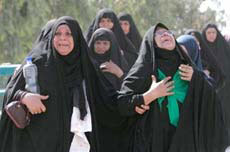
Shiite
women mourn their beloved ones killed in the Wednesday's stampede.
(Reuters)
|
Urging
each others to help the affected Shiites, Al-Aazamiya residents also
sped with their private cars to take the injured to Al-Noaman hospital
for treatment.
"Residents
also used their carriages, used to carry vegetables and grocery, to move
the injured to the main streets where the ambulances can move them to
hospitals," Rahim, a vegetables salesman, told IOL.
Ambulances
could not reach out to pick up the injured Shiites from the Aaimmah
bridge where concrete barriers were put by Iraqi security forces as part
of tightened security measures in the area.
Many
Sunni and Shiite observers and officials put the blame largely with the
occupation forces and Iraqi government for not doing enough to organize
and secure such huge gatherings of people.
Abbas
Al-Rabbi of the Martyr Sadr Office said the US occupation forces were
unable to maintain order in the Shiite religious occasions due to their
ignorance of the traditions of the Iraqi people.
Sheikh
Harith Al-Dari, chairman of the Association of Muslim Scholars, the
highest Sunni body in Iraq, said the positive side of the tragedy is
that it showed the strong bonds among Iraqis of all religious sects and
dealt a heavy blow to inciters and hate-mongers.
Welcome
Hospitals
were filled Wednesday with the sounds of screaming and wailing as
disconsolate men and women searched for loved ones.
Television
showed heart-rending images of women weeping over the bodies of their
dead children in hospitals. Dozens of bodies were strewn across the
floor.
To
alleviate the burden on hospitals, people of Al-Aazamiya opened doors of
their homes for the wounded, especially women and children, to offer
immediate help.
Sunni
mosques, such as the mosques of Abu Hanifa Al-Noaman and Beshr Al-Hafi,
also opened doors to offer help to the injured and move them to
hospitals.
"People
of Al-Aazamiya helped tens of thousands of Shiite pilgrims who were
passing by on their way to commemorate the death of imam Musa Al-Kadhim,"
said Mohamed Mahrous, a leading public figure in Aazamiya.
He
denied the Shiite pilgrims had faced any harassment while passing in the
area.
"On
the contrary, the people of Al-Aazamiya used to show warming welcome to
the Shiite pilgrims and offer them with food and water. That was the
case Wednesday."
Political
analysts and observers saw the great show of Shiite-Sunni solidarity
Wednesday as a strong message the electoral battle to endorse a draft
constitution, that highlights federalism, would be a heated one, arguing
Sunnis and strong currents of the Shiite sect would be joining hands to
give the chart the thumbs down.
|