|
Thai Muslims Fear "Collective Punishment"
 |
|
Murder
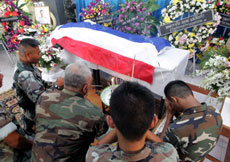
of the two marines risks anti-Muslim massive attacks. (Reuters)
|
BANGKOK,
September 22, 2005 (IslamOnline.net & News Agencies) – Thai
police and troops Thursday, September 22, mounted a door-to-door
search for the killers of two navy officers, sparking fears of massive
anti-Muslim attacks despite the Thai Premiere's pledge to the
contrary.
"I
can assure you that there will be not be retaliation," Thaksin
told a weekly news conference Thursday, a day after two plain-clothes
marines were abducted and brutally beaten to death in the house where
they had been held on suspicion of being government hit-men.
"There
will be law enforcement," said Thaksin, a former policeman,
according to Reuters.
Analysts,
however, told Reuters that the murder of the soldiers, captured by
Muslim villagers after a fatal shooting in Narathiwat province
Tuesday, could inflame the "separatist unrest" that has
gripped the region and claimed 900 lives in 21 months.
With
sweeping emergency powers and 30,000 troops and police in Narathiwat
and neighoring Yala and Pattani -- where 80 percent of the population
are Muslim, ethnic Malay and do not speak Thai -- Thaksin has not been
one to push the soft approach, Reuters said.
Thai
marines' commanding officer, Captain Traikwan Krairiksh, summed up the
sense of outrage which could unleash a wave of "reprisal
killings" in a region where rumors of government death squads are
already rife.
"I
am furious. They killed my men. If I could, I would drop napalm bombs
all over that village," Traikwan was quoted as saying by the
Bangkok Post.
The
daily quoted another unnamed marine as saying he would "make the
killers pay".
Thaksin's
government, heavily criticized for its 2003 "war on drugs"
in which 2,500 people died, denies any of its security forces have a
"license to kill".
Confusion
still surrounds the exact circumstances behind Tuesday's shooting at
the Narathiwat teashop, in which one person was killed and four
wounded.
Villagers
say the marines were involved, but the government blames the incident
on separatist militants, claiming the marines were sent to try and
catch the suspects and help the injured.
Fearing
a repeat of last October's Tak Bai incident, in which 78 Muslims died
in army custody, others challenged Thaksin not to get involved in a
vicious cycle of violence, Reuters reported.
Thailand's
national rights watchdog accused the army earlier of "violent
breaches of human rights" against Muslims in the south.
Blame
 |
|
Shinawatra’s
policies are blamed for escalating violence. (Reuters)
|
Some
analysts believe that although the murder was undertaken by Southern
villagers, the government still shares a great deal of blame.
According
to Agence France- Presse, Shinawatra adopted an Iron Fist strategy
from the very outbreak of the unrest in January 2004, a strategy that
critics say has only worsened the situation by militarizing the region
and alienating residents.
"As
long as Mr. Thaksin's hardline policies are still there, we will
continue to have problems like this," Senator Kraisak Choonhavan
told Reuters.
Murder
accusations were automatically directed to "Southern Muslim
villagers" despite the fact that south villages are heavily
inhabited by convicted criminals, who might have undertaken the
murder, AFP reported.
In
this respect, Defense Minister Thammarak Issarangura Na Ayutthaya said
in Bangkok that three suspects had links with gangs of drug
traffickers who work along the border with Malaysia, rather than with
“Islamic separatists” are also active in the region, according to
AFP.
The
New York Times reported July
6 that the harsh, militarized policies of the Thai government in the
violence-wracked Muslim-majority south have generated spiraling
dynamic of violence
and revenge in the area, leaving Thai Muslims living in fear and
horror.
According
to AFP, Surichai Wankoew, a member of the National Reconciliation
Commission tasked with building peace in the south, warned the
government not to slip into violence.
"The
tragedy yesterday will surely make things more complicated, but the
government must be patient and separate the perpetrators from innocent
villagers,” AFP quoted Wankoew as saying Thursday.
Thailand
is a predominantly Buddhist nation but Muslims make up about five
percent of the population and mostly live in the five southern
provinces bordering Malaysia.
Pattani,
Yala and Narathiwat are the only Muslim majority provinces in the
country. The southern region was once an independent Muslim sultanate.
|