|
60 Killed in Russia Attacks, Putin Orders Shoot-to-Kill
 |
|
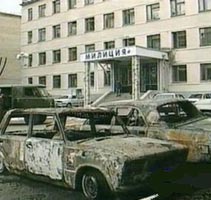
A TV grab shows burnt cars stand in front of a police station in downtown Nalchik. (Reuters)
|
NALCHIK,
Russia, October 13, 2005 (IslamOnline.net & News Agencies) –
More than 60 people have been killed Thursday, October 13, in
simultaneous attacks on government buildings in the southern Russian
city of Nalchik claimed by Chechen fighters, as President Vladimir
Putin ordered sealing off the city and issued shoot-to-kill orders for
any person who puts up armed resistance to security forces.
Firefight
broke out in Nalchik, the main city of the Muslim Kabardino-Balkaria
region near Chechnya, when gunmen launched a series of coordinated
attacks on several government buildings, reported Reuters.
Deputy
state prosecutor Vladimir Kolesnikov told reporters up to 100 fighters
had simultaneously attacked three police stations and other buildings
housing border guards, Federal Security Service (FSB) officials,
special riot police and an anti-terrorist center.
He
said 20 fighters were killed and 12 of their number seized by security
forces while Itar-Tass news agency said Russian forces killed 50 of
the attackers.
Moscow
radio said that 20 members of the Russian security forces had also
been killed in the clashes.
A
source at Nalchik's Republican Hospital told Ekho Moskvy radio that 20
dead had been brought in, "all people in uniform".
At
least 40 injured people had been taken to the hospital, with more
arriving all the time, the source added.
Footage
broadcast by Russia's NTV television station showed several corpses
lying in the streets in pools of blood and covered over with blankets
during the attack launched around 9 a.m. and winding down around
midday.
Interfax
news agency said the attackers also attempted to attack the Nalchik
airport but were thwarted.
Nalchik
is located some 150km west of the Chechen capital Grozny.
Hostages
Dmitry
Kozak, President Vladimir Putin's special envoy to the area, told
Russian television that an operation was under way to free hostages
taken by the attackers, reported Agence France-Presse (AFP).
"There
are clashes in more than two areas. It is at police station number
three where, unfortunately, there are hostages. An operation is under
way to try to secure their release," he said.
But
Kozak did not say how many hostages were being held.
Describing
the attacks as an organized assault "on the law enforcement
system of the city", the Russian official said armored vehicles
and special forces troops were involved in efforts to subdue the
attackers.
Shoot-to-Kill
Orders
 |
|
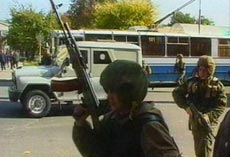
A TV grab shows Russian security forces taking position in Nalchik. (Reuters)
|
Putin,
who came to power in 2000 by talking tough on Chechnya, ordered
sealing off the southern city and issued shoot-to-kill orders for any
person who puts up armed resistance to security forces.
"The
president ordered that not a single fighter be allowed to leave the
city limits," Deputy Interior Minister Alexander Chekalin said as
after meeting the Russian leader at his official country residence
outside Moscow.
"Anyone
who puts up resistance with weapons in his hands must be
liquidated" on the spot, he added.
"This
order from the president will be carried out."
Putin's
orders are a gloomy reminder of the Beslan hostage crisis when Russian
security forces stormed s school in northern Ossetia in early
September, 2004 to free some 400 people taken hostage by Chechen
fighters.
Web
Claim
A
statement posted on an Internet Web site used regularly by Chechen
fighters said the attack was mounted by a unit of the Caucasus Front
of the Armed Forces of the Chechen Ishkeria Republic.
The
Kavkaz center web site said the fighters belonged to the "Yarmuk
jamat of Kabardino-Balkaria."
Interfax
quoted an official as saying that the attacks were in reprisal for the
recent arrest in Nalchik of a group of Islamists, whom the gunmen were
attempting to free.
The
Yarmak unit was the target of a swoop by security forces in January.
The
Nalchik attack was the latest in a series by Chechen fighters on
Russian federal security installations in the volatile North Caucasus
region.
Large
teams of Chechen fighters have carried out similar attacks in other
cities in the region in the past with one of their key tactical
objectives apparently being the acquisition of weapons from security
personnel.
The
small mountainous Caucasus republic has been ravaged by conflict since
1994, with just three years of relative peace after the first Russian
invasion of the region ended in August 1996 and the second began in
October 1999.
It
was on December 11, 1994 that former Russian president Boris Yeltsin
ordered Russian troops into Chechnya to subdue an increasingly
powerful separatist movement.
After
two years of horrific fighting, Russian troops pulled out in 1996.
In
1999, then-prime minister Vladimir Putin pushed some 80,000 Russian
troops into Chechnya in what Moscow called a lightning-strike
“anti-terror operation” but which has since degenerated into a
grinding war with Chechen fighters.
At
least 100,000 Chechen civilians and 10,000 Russian troops are
estimated to have been killed in both invasions, but human rights
groups have said the real numbers could be much higher.
Thousands
of refugees from war-torn Chechnya live in battered tent camps in
neighboring Ingushetia and refuse to return home because of continuing
insecurity.
|