|
Aussie Muslims Shaken by "Terror Swoops"
 |
|
"This
is not going to end speculation about the Muslims and the
religious and racial profiling of people which we fear from the
new terrorism laws," Mehboob said.
|
SYDNEY,
November 8, 2005 (IslamOnline.net & News Agencies) – Australian
Muslims warned Tuesday, November 8, a pre-dawn "terror
arrests" within the Muslim minority will spark renewed
anti-Muslim hatred as analysts said home-grown "militants"
in Australia and other countries are driven by the Iraq occupation.
"It's
two-fold, they (Muslims) are frightened about the events that are
taking place around them, like everybody else," Amjad Mehboob,
chief executive of the Australian Federation of Islamic Councils, told
the Australian Associated Press news agency, according to Agence
France Presse (AFP).
"But
they are doubly concerned about the fallout. This is not going to end
speculation about the Muslims and the religious and racial profiling
of people which we fear from the new terrorism laws," Mehboob
added.
The
response came after Australian police said Tuesday they arrested 16
people, including an a Muslim imam, in pre-dawn raids in Sydney and
Melbourne, alleging that the pre-emptive strikes were to foil a
"large-scale terrorist attack".
Police
said seven people were arrested in Sydney and nine in Melbourne in
swoops on more than 20 homes in the country's largest
"counter-terrorist" action after a 16-month investigation.
One
of the Sydney suspects was shot in the neck and critically injured
after he fired at police who ordered him to stop as he walked along a
suburban street, police added.
The
operation came nearly a week after Australia's anti-terror laws were
changed to give police greater powers.
Anti-Muslim
Hatred
 |
|
Video
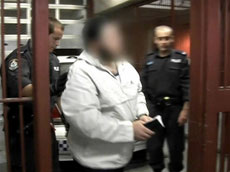
grab shows man being led into a cell after being arrested in
Sydney (Reuters)
|
Australian
Muslims, on their part, fear that the Tuesday's arrests would fuel
hate crimes against the Muslim minority, AFP said.
Waleed
Aly, a spokesman of the Islamic Council of Victoria, said there had
recently been an increase in the anti-Muslim hate crimes.
"Crimes
range from people being spat on, to assaults, headscarves being ripped
off. It's pretty horrible stuff," he said.
Keysar
Trade of the Islamic Friendship Association echoed a similar concern,
saying that talk-back radio had been "full of vitriolic comments
about Muslims" after the Tuesday's arrests.
"This
is what we're facing, it's certainly not an enviable position to be
in," he told AFP.
Australian
Muslim leaders, however, expressed hope that the arrests would ease
suspicion of Muslims and give those charged a chance to defend
themselves.
"I
think what we're happy about is that there have finally been some
arrests made and charges laid," Aly said.
"Because
what's been really disconcerting in the past has been a series of
raids that have amounted to nothing. That creates suspicion and that
creates fear."
Muslims,
estimated at 300,000, make up just 1.5 percent of Australia's
population of 20 million.
Australian
Muslims warned that the security measures create a climate of fear and
apprehension among the Muslim minority in the country.
Iraq-driven
Militants
In
a related development, terror analysts said the US-led occupation of
Iraq has been the main cause of home-grown terrorists in Australia and
other European countries.
"What
we are seeing in Australia is jihadi (Islamic holy war) support cells
in the process of mutating in the post-Iraq environment into attack or
operational cells," Rohan Gunaratna of the Singapore-based
Institute of Defense and Strategic Studies, was quoted as saying by
AFP.
"There
are at least four dozen Australians, mostly first and second
generation Muslims, trained in Afghanistan and Pakistan who are today
ideologically driven by the global developments in Iraq," he
added.
Robert
Broadfoot of the Hong Kong-based Political and Economic Consultancy
said the July 7 attacks in London and earlier in Madrid also pointed
to Iraq as a driving force behind "Islamic militancy".
"But
it would be wrong to simply say it's because of Afghanistan and Iraq
and the support of the US," he said.
"That's
part of it but I think in the minds of many of these extremists
Australia is an enemy in its own right -- it's not Muslim, it's
identified culturally as more of a western country."
Australia,
like Britain, is a close ally of the United States in its so-called
"war on terror", and contributed troops to the invasions of
both Afghanistan and Iraq.
Australia
has never suffered a major peacetime attack on home soil, but 88
Australians were among 202 people killed in the 2002 Bali bombings and
10 Indonesians were killed when the Australian embassy in Jakarta was
hit by a suicide bomb on September 9, 2004.
|