|
Sunnis Welcome US Bid to Talk With Resistance
 |
|
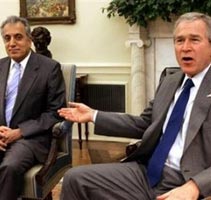
Bush, right, has authorized the US ambassador in Iraq to hold talks with Iranian officials on Iraq. (Reuters)
|
BAGHDAD,
November 30, 2005 (IslamOnline.net & News Agencies) – Iraqi
Sunnis have welcomed a declared US initiative to talk with Iraqi
resistance groups, saying the US step demonstrates a new approach in
dealing with the Iraqi crisis.
US
ambassador to Iraq Zalmay Khalilzad has said that the US was reaching
out for talks with "insurgent groups" -– the US term for
the Iraqi resistance groups.
"The
remarks illustrate a more rationalized approach by the US
administration in dealing with the Iraqi issue," Saleh Al-Mutlaq,
leader of the Sunni umbrella body Iraqi National Dialogue Council,
told the Doha-based Al-Jazeera Tuesday, November 29.
Al-Mutlaq
further expressed hope the US initiative will be immediately put for
implementation.
He
said that an understanding could be reached with resistance groups
that work for ending the US occupation of Iraq.
Unabated
resistance attacks, which started after the US occupation in 2003, has
left so far up to 2,100 US servicemen killed, sending shockwaves
across the United States.
In
addition, the majority of resistance factions have always sought to
distance themselves from militant groups who target mosques and
civilians.
No
Zarqawi
Speaking
on the ABC television network Monday, Khalilzad said he was open for
negotiations with any of the various "insurgent" groups,
excepting Saddam Hussein loyalists and followers of Al-Qaeda front man
Abu Musab Al-Zarqawi, Agence France Presse (AFP) said Tuesday.
"We
are reaching out to everyone but two groups: the Zarqawi group and
associated forces who are jihadists... and the Saddamists. Those who
want Saddam Hussein to return," Khalilzad said.
The
US ambassador gave no details of the groups he hoped to negotiate
with. But he indicated the groups were from the Iraqi Sunni minority.
"If
we want an Iraq that works we need to bring the Sunnis into the
political process," he said.
Speaking
on the sidelines of the Iraqi National Accord Conference November 19,
Iraqi President Jalal Talabani said he was ready to receive members of
resistance movements in his capacity as the "president of all
Iraqis."
"If
those who call themselves the Iraqi resistance desired to contact me,
I would welcome them. I would not refuse to meet any Iraqi who wants
to meet me. But of course that does not mean I will accept what they
say," he said.
Crucial
Elements
The
US ambassador said that other governments in the region had been
crucial in making contacts with the Iraqi groups.
"We
have in recent periods sought the help of countries, Sunni Arab
countries to facilitate that, to encourage that," he said.
"I
believe you cannot win the kind of conflict we are facing by military
means alone... You need to have an integrated approach that wins
populations over," Khalilzad said.
He,
however, stressed that no overtures could be made to the Zarqawi
group, which he said wanted to foment a civil war, or the Saddam
supporters.
"Saddamism
is dead, it isn't coming back. I repeat that constantly when I see
Sunni leaders.
"The
Sunni outreach, as we call it, aims at isolating these two groups and
winning over the population away from them."
Iran
Meanwhile,
the US ambassador was to hold talks with Iranian officials on Iraq,
the first high-level talks for decades between the two sides.
"I've
been authorized by the president to engage the Iranians as I engaged
them in Afghanistan directly," he said.
"There
will be meetings, and that's also a departure and an adjustment."
But
the US State Department said Khalilzad had a narrow mandate to focus
only on Iraq, and that the talks would not affect bilateral relations.
"It's
a very narrow mandate that he has, and it deals specifically with
issues related to Iraq," State Department spokesman Sean
McCormack told reporters.
US
Secretary of State Condoleezza Rice signaled last month that
Washington was looking at the possibility of direct contact with Iran
as part of efforts to get on top of the violence in Iraq.
"We're
considering whether that might be useful," Rice told the Senate
Foreign Relations Committee on October 19.
|