|
Bush Maps Out Iraq Strategy, Public Opinion Hardens
 |
|
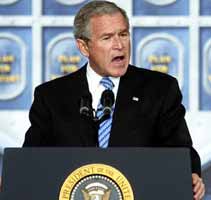
"America will not run in the face of car-bombers and assassins so long as I am your commander in chief," said Bush (Reuters)
|
ANNAPOLIS,
Maryland, November 30, 2005 (IslamOnline.net & News Agencies) US
President George W. Bush mapped out in a speech Wednesday, November
30, the future US strategy in occupied Iraq, saying that US troop
levels in Iraq would depend on conditions there, not on
"artificial timetables."
His
speech came as public opinion hardens against a conflict which has now
killed more than 2,100 US soldiers.
"Decisions
about troop levels will be driven by the conditions on the ground in
Iraq and the good judgment of our commanders, not by artificial
timetables set by politicians in Washington," Bush told an
audience at the US Naval Academy, reported Agence France-Presse (AFP).
"America
will not run in the face of car-bombers and assassins so long as I am
your commander in chief," he said, striking a defiant tone in the
face of drooping popularity and mounting criticisms at home.
He
said "victory" will come when the "terrorists and
Saddamists can no longer threaten Iraq's democracy."
The
speech was the first in what aides said would be a series, ahead of
Iraq's December elections, laying out the US strategy in occupied
Iraq.
Bush
took pains to praise Iraq's fledgling security forces, acknowledging
in the meantime "some setbacks" in training army and police
forces and that "their performance is still uneven in some
areas."
But
he said there had been steady progress even though only one battalion
needs no US help.
"Not
every Iraqi unit has to meet this level of capability in order for the
Iraqi security forces to take the lead in the fight against the
enemy," Bush said.
"Central
Terror Front"
 |
|
Bush greets midshipmen at US Naval Academy before his speech. (Reuters)
|
Bush
further said that Iraq has become the central front in Al-Qaeda's
"war against humanity."
He,
however, acknowledged that foreigners were the smallest part of the
"insurgency," a term used by the US military and its allies
to describe the unabated resistance in Iraq.
"The
terrorists have made it clear that Iraq is the central front in their
war against humanity," Bush said.
"So
we must recognize Iraq as the central front in the war on
terror."
He
said foreign fighters affiliated with or inspired by Al-Qaeda
represented "the smallest but the most lethal" group
fighting the US-led forces in Iraq.
He
said that "by far the largest group" were "ordinary
Iraqis, mostly Sunni Arabs who miss the privileged status they had
under the regime of Saddam Hussein."
Bush
said the second largest group was "smaller but more determined.
It contains former regime loyalists, who held positions of power under
Saddam Hussein. People who still harbor dreams of returning to
power."
Nezar
Al-Samarai, an Iraqi journalist, played down Bush's speech as a
"collection of well-chosen clichés."
"It
seems as if Bush was outlining how to protect the US forces in Iraq in
the days to come, not the Iraqi people," he told Al-Jazeera
satellite channel.
"He
greeted some US and Iraqi troops by name throughout his speech and
even quoted some of his soldiers about their experiences in
Iraq."
Weary
Americans
Recent
polls have found the president at the lowest standing of his time in
office, with a majority critical of his handling of the war just one
year before November 2006 US legislative and gubernatorial elections.
His
Republicans are increasingly worried about the price they may pay at
the ballot box, while opposition Democrats including some likely 2008
presidential contenders have pushed him to set a withdrawal timetable.
"We
can't stay, we can't leave, and we can't fail," was how a recent
report by the US Army War College summed up the situation.
Those
who want the troops home now believe Americans in Iraq are catalyzing
the "insurgency."
"We're
the targets ... we're uniting the enemy against us," said hawkish
Democratic lawmaker John Murtha this month, touching off fierce debate
on the US position in Iraq.
The
United States should "immediately redeploy" its forces, and
create a rapid reaction force to contain flare ups, he said.
Before
Bush spoke, his national security council released a 35-page policy
paper that predicted a reduction in the US military presence in 2006
but warned there was no "date certain" for a complete
pullout or for victory.
"Many
challenges remain," it said, warning that "terrorism and
insurgencies historically take many years to defeat" and that
"Iraq is likely to struggle with some level of violence for many
years to come."
There
are currently some 159,000 US troops there, and some 2,100 have been
killed since Bush launched the March 2003 invasion to topple Saddam
Hussein.
The
Pentagon said Monday, November 28, US forces would be reduced as
expected by 20,000 to about 140,000 after December's elections.
And
in another sign of a gradual drawdown, the White House said Saturday,
November 26, that Democratic Senator Joseph Biden's plan for a 50,000
troop drawdown next year was "remarkably similar" to its
own.
Papers
Bribed
 |
|
"We
can't stay, we can't leave, and we can't fail," was how a recent report
by the US Army War College summed up the situation. (Reuters)
|
Separately,
The Los Angles Times reported on Wednesday that the US military
was secretly paying Iraqi newspapers to print stories written by US
soldiers in an effort to polish the image of the American occupation
in Iraq.
US
military "information operations" troops have written the
articles, which are translated into Arabic and placed in Baghdad
newapapers with the help of the Lincoln Group, a Washington-based
defense contractor.
Many
articles are presented to Iraqi newspapers as unbiased news accounts
written and reported by independent journalists, the daily said,
citing documents it obtained and unnamed US military officials.
The
stories denounce "insurgents" and tout the work of US and
Iraqi troops and the US-led effort to "rebuild" Iraq.
The
Lincoln Group helps translate and place the stories. The contractor's
Iraqi staff, or its subcontractors, sometimes pose as freelance
journalists or advertising executives to hand the stories to Iraqi
papers, according to the US daily.
Some
senior US military officers in Iraq and at the Pentagon have
criticized the operation, saying it could ruin the US military's
credibility in other countries and with the US public.
"Here
we are trying to create the principles of democracy in Iraq. Every
speech we give in that country is about democracy. And we're breaking
all the first principles of democracy when we're doing it," a
senior Pentagon official who opposes the planting of stories was
quoted as saying.
|