|
Five Israelis Killed in Palestinian Bombing
 |
|
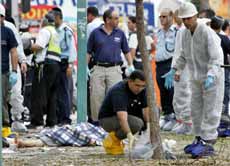
Israeli police and crime scene investigators survey the scene of the bombing. (Reuters)
|
Additional
Reporting by Mustafa el-Sawwaf, IOL Correspondent
NETANYA,
Israel, December 5, 2005 (IslamOnline.net & News Agencies) - Five
Israelis were killed and dozens others were wounded Monday, December
5, when a Palestinian bomber blew himself up at the entrance to a
shopping mall in the northern coastal town of Netanya.
The
Islamic Jihad claimed its responsibility for the attack at the
Hasharon mall, the target of a similar bombing less than six months
ago, reported Agence France-Presse (AFP).
It
named the bomber as 21-year-old Lotfi Amine Abu Saada from a village
near the northern West Bank city of Jenin, saying the attack came to
avenge the killing of its West Bank leader Luai Al-Saadi almost one
month ago.
Police
said the bomber was carrying several kilograms of explosives but was
prevented from entering the mall by a policeman and a guard at around
11:30 a.m. (09:30 GMT).
Israeli
police said a greater tragedy was prevented by an alert policewoman at
the entrance to the mall, who spotted the bomber and alerted the
guards.
Apart
from the bomber, four people died at the scene of the blast and a
fifth died of his wounds in hospital, police and medical sources said.
Another 30 people were injured.
An
AFP correspondent at the scene said four badly burned bodies could be
seen lying on the road outside the mall. Glass and rubble littered the
area while nearby buildings had their windows blown out. Witnesses
said the blast was deafening.
The
blast was the first bombing since late October, when another Islamic
Jihad bomber blew himself up in the northern town of Hadera killing
six Israelis.
Vicious
Cycle
Mostafa
Al-Barghouthi, head of the Palestinian National Initiative, said the
continued Israeli attacks, arrests and raids on the Palestinians are
turning on a vicious cycle of violence once again.
Barghouthi
told Al-Jazeera satellite channel that it was not logical that Israel
accused the Palestinian Authority of failing to stop such attacks.
 |
|
Palestinian bomber Lotfi Abu Saada, over a decade ago. (Reuters)
|
“How
on earth the Palestinian Authority with its limited potential can stop
these attacks while Israel with its military juggernaut and the West
Bank separation wall cannot?” he wondered.
Hassan
Abu Hashish, a Palestinian political expert, held Israel accountable
for the violence.
“The
Palestinians have found themselves on the defensive in the face of the
Israeli war machine,” he told IslamOnline.net.
“The
international community, in a nutshell, should pressure Israel into
stopping its almost daily aggressions on the Palestinians to give an
impetus to the dormant peace process,” he said.
Hashish,
however, said the attack could give Israel an excuse to disrupt the
legislative polls in January.
The
elections are due January 25, 2006, with all factions participating
except Islamic Jihad which chose to boycott the process.
Condemnation
Palestinian
President Mahmoud Abbas condemned the attack as "terrorism"
and vowed to bring the perpetrators to justice.
“We
severely condemn this terrorist operation in Netanya,” a statement
from his office said.
“President
Abbas has ordered all the security services to catch whoever is
responsible for this attack and bring them to justice.”
Jacob
Walles, the US consul general for east Jerusalem, told reporters in
Ramallah that the attack was aimed at undermining peace efforts.
“People
who are behind this attack are the enemies of peace and are
undermining the interests of the Palestinian Authority. We will
continue our efforts to work with parties to advance the peace
process,” he added.
The
European Union also condemned the attack, saying it was a clear
attempt to undermine the revived peace process.
“I
condemn in the firmest manner the terrorist attacks that took place
this morning in Netanya,” said EU foreign policy chief Javier
Solana.
The
European Union is part of the Mideast Quartet -- along with the United
States, Russia and the United Nations -- backing the peace process.
Concretely,
the bloc sent an EU observer mission to monitor the re-opened Rafah
border crossing from the Gaza Strip to Egypt, operating without direct
Israeli control for the first time since the 1967 Middle East war.
The
attack further drew condemnation from Egypt.
“These
actions must stop,” Foreign Minister Ahmad Abul Gheit told
reporters.
Such
attacks “greatly harm the chances of the Palestinians to achieve
their rights and establish their own state,” he added.
Egypt
has been involved in mediation efforts between Israel and the various
Palestinian factions in a bid to secure a truce following the Israeli
withdrawal from the Gaza Strip.
|